
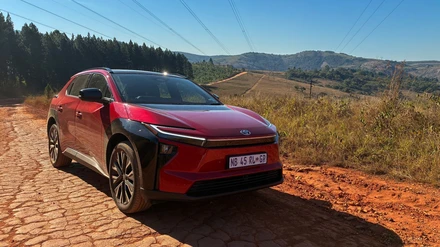
First Drive: GWM Ora 5
The Ora brand struggled to find its footing in SA as an EV-only outfit. Now it's back with the Ora 5 and a variant for everyone
GWM’s Ora brand hasn’t had an easy time of it in South Africa. It launched here in 2022 as the Chinese marque’s EV-only division, right as local buyers decided they weren’t quite ready for EVs after all.
Local EV adoption is still moving at a snail’s pace, with hybrids the preferred stepping stone because they sidestep the range anxiety still clouding most fully electric cars. That left the Ora 3, GWM’s only offering at the time, out of reach for most SA buyers. It’s forced GWM to rethink the brand: instead of selling EVs exclusively, Ora now offers a full spread of powertrains since not everyone wants (or is ready for) an EV.
Leading that charge is the new Ora 5, available in ICE, hybrid (HEV) and full-EV guises, all priced under R600,000.
What Does the GWM Ora 5 look like?
The retro look is what’s always set Ora apart from the rest of the market, and the Ora 5 keeps that going. Yes, there’s some influence from British and German SUVs in there, but it’s a clean design that feels natural. If you’re after a family SUV that doesn’t look like a Chery Tiggo 4 Pro, Lepas L4 or Volkswagen T-Cross, this is worth a look.
Big round headlights, roof rails, 18-inch wheels, and taillights integrated into the rear glass give it a clean, cohesive stance.
It’s also bigger than the electric Ora 3, measuring 4,471mm long, 1,833mm wide and 1,641mm tall.
What is the GWM Ora 5’s interior like?
Step inside, and the retro theme continues. If you know the current Mini Countryman, you’ll get a strong sense of déjà vu, from the design details down to the toggle switches and stitching. That’s not necessarily a bad thing, though, since the interior feels genuinely premium, with soft-touch materials covering most surfaces.
Following the trend among Chinese manufacturers right now, a large 14.6-inch infotainment screen, running GWM’s latest Coffee OS, acts as the gateway to most of the Ora 5’s functions. It admittedly took me some time to learn where everything lives. There’s also a 10.25-inch instrument cluster, a smartphone wireless charging pad, a panoramic glass roof, and enough cubby space to swallow a couple of water bottles.
As for the space, there’s a generous amount, and for that reason it should appeal to most family SUV buyers. The boot offers 362 litres of luggage capacity with all the seats in place. That’s slightly down on the VW T-Cross’s 385 litres but comfortably ahead of the Chery Tiggo 4 Pro’s 340 litres, making it more than adequate for those family weekend aways.
Is the GWM Ora 5 safe?
Good question. The Ora 5 range comes with six airbags as standard and an extensive suite of active and passive driver assistance systems, such as adaptive cruise control, autonomous emergency braking, blind-spot monitoring, lane-keep assist, a 360-degree panoramic view, ABS, and traction control, amongst others.
What Engines and Powertrains Does the GWM Ora 5 Offer?
The range is quite straightforward. You get two trim levels, Super Luxury and Ultra Luxury. Furthermore, there is an ICE-powered variant which is powered by a 4-cylinder 1.5-litre turbocharged petrol engine with 105kW and 210Nm. The transmission is a 7-speed DCT that drives the front wheels. This is the version for buyers who simply want a conventional driving experience. There’s no need to think about charging cables, public chargers or range anxiety, just fill the tank and go.
Then there’s the HEV, which makes use of the same engine but pairs it with a high-output electric motor. The combined power output is rated at 164kW and 476Nm. It swaps the DCT for a 2-speed Dedicated Hybrid Transmission (DHT), which is definitely the pick of the bunch here. You can still fill up with petrol as you normally would, but the battery pack recharges itself while driving, so there’s no need to plug it in. It’s the ideal middle ground for buyers who prioritise hybrid efficiency without committing to a fully electric car.
At the top is the fully electric model with a front-mounted e-motor with 150kW and 260Nm, powered by a 58.3kWh battery pack. GWM claims it can travel up to 520km on a single charge. If it comes anywhere close to that in real-world conditions, it should be more than enough for the vast majority of daily commutes and even the occasional road trip with a planned charging stop.
What Is the GWM Ora 5 Like to Drive?
Only the ICE and HEV were available at launch, and both lean toward comfortable cruisers.
Starting with the ICE model, it feels eager from the moment you pull away. The 1.5-litre turbocharged engine delivers a healthy amount of low-end shove, making it well suited to urban driving and effortless overtaking in everyday traffic. The suspension is comfortable and soaks up most road imperfections without unsettling the cabin, and the steering is light enough to make parking manoeuvres a straightforward task.
Out on the open road, however, the engine starts to lose some of its enthusiasm. While there’s enough performance for cruising and the occasional overtake, it doesn’t feel particularly eager once you venture higher up the rev range. At motorway speeds, there’s also a noticeable amount of wind noise around the mirrors and A-pillars, which becomes more apparent the faster you travel. It’s by no means intrusive, but it’s something you really notice on longer trips.
The hybrid delivers a very similar driving experience, although you can feel the extra weight. At 1,560kg, it’s around 110kg heavier than the petrol model’s 1,450kg, and while it isn’t enough to dull the driving experience, it does make the car feel slightly less eager when changing direction.
Where the hybrid really impresses is in the way it blends its petrol engine and electric motor. The transition between the two power sources is almost unnoticed, with the system switching seamlessly depending on the driving conditions. Around town, it feels refined and relaxed, while the instant shove from the electric motor gives it a little more urgency off the line than the conventional petrol model.
Is the GWM Ora 5 Worth Buying?
For most buyers, yes, particularly in HEV guise.
The original Ora 3 always felt like a car that was a good idea, which was ahead of its time for the South African market. While it was the most affordable EV when it launched, asking buyers to jump straight into a fully electric car proved to be a tough sell. With the Ora 5, GWM seems to have finally read the room by offering it in different powertrain options.
Based on my first drive, it’s the HEV that stands out in the range, as it offers buyers the efficiency benefits that come with electrification without forcing them to change the way they use their car. With what the Ora 5 brings to the table, it’s a very credible alternative to the established players in SA’s compact crossover segment.